


Authors: Dr. Zeimpekis - Executive Advisor at OPTILOG Advisory Services / I. Fragkiadaki - Junior Consultant at OPTILOG Advisory Services
1. Challenges in the urban environment
Nowadays, more than 2/3 of the global population live in urban areas, and this number is expected to overcome 80% by 2050. Cities hold the greatest part of economic and production activities, and they consume the most of available resources and energy. As a result, urban areas face significant negative impacts that are caused by human activities. Freight and passenger vehicles are the main responsible for most of the impacts, including congestion, high levels of greenhouse gas emissions and noise pollution.
The objective of Sustainable City Logistics is the optimization of logistics services in urban areas, considering economic, environmental and social aspects. Furthermore, urbanization is a challenge that creates opportunities for the development of new technologies and sustainable transport systems, seeking solutions tailored to the characteristics of each city. The key driver is the efficiency of freight and passenger transportation in urban areas for the development of a competitive economy that will attract new investors.
2. Examples of best practices for sustainable urban freight transport
Use of cargo bikes for the last mile logistics in Beijing
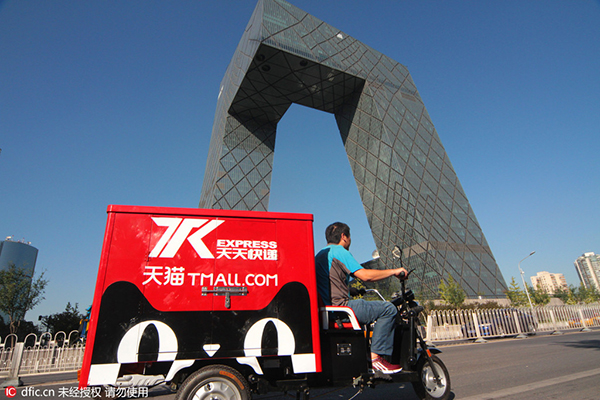
Cargo bikes have been widely used for the last mile logistics in the cities of China. The vehicles which are used for the deliveries are electric and rechargeable by household sockets. It is estimated that in Beijing are used 15.000 to 20.000 cargo bikes for the distribution of products while the proportion of home deliveries is 90%. The need for real-time deliveries as well as for low-cost services was the main reason for the success of this practice. Furthermore, the use of cargo bikes provides additional benefits, including negligible greenhouse gas emissions and flexible parking at delivery areas. However, the distribution by using cargo bikes has been a controversial issue for the Chinese authorities, due to the security issues that arise. To this end, the growth in e-commerce makes imperative the use of cargo bikes for the last mile logistics, so the authorities are setting out safety rules to legalize their use.
Use of vessels for the distribution of goods to the supermarkets in Paris
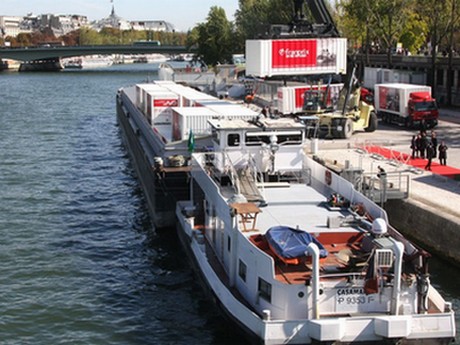
Franprix enterprise in Paris implements a new project which concerns using multi-modal freight transport in urban areas in order to supply the retail stores. More specifically, the last part of the freight transport procedure which is the distribution from regional centers to retail stores is conducted by vessels. The goods are placed in a special container and they are shipped from the distribution center to a specified port of Sicuana river, by truck. Then, a vessel transfers the goods to the banks of Sicuana river which are located in the center of Paris. The distance from the port to the Quai de la Bourdonnais is 20km and from there another truck is responsible to transfer the goods to the retail stores. This project contributes to the reduction of travel kilometers and leads to savings of 250 tons of carbon dioxide emissions per year. To this end, additional benefits stem from the reduced use of trucks in urban areas (congestion, noise pollution, and accidents).
Cargo loading and unloading of trucks in Lisbon with parking surveillance technologies
The Lisbon Mobility and Parking Municipal Company (known as EMEL), has developed a new project that aims to tackle the problem of vehicle loading and unloading in drop-off points. This practice was developed in order to tackle traffic congestion that was responsible for the congestion of roads due to the illegal parking of trucks. The project is based on the development and implementation of customized parking meters that issue special 30-minute tickets for freight vehicles during the loading/unloading process. At the same time, sensors, which detect the presence of a vehicle in the temporary parking area, communicate with the control center (EMEL) and information about the vehicle's parking time. The main benefits of this project are the fewer breaches, the shorter loading/unloading time and greater satisfaction of both shopkeepers and logistics companies.
3. Investing in natural gas refueling stations and evaluating the use of NG as a fuel in freight transport vehicles
The investment of a compressed natural gas station network has many positive effects both in the economy as well as in the society and the environment. Τhe operation of CNG filling stations can be examined via a socio-economic study.
Cost-Benefit Analysis (CBA) is an analytical tool for examining the economic advantages or disadvantages of an investment. The assessment is taking place by evaluating its costs and benefits in order to identify the impact of adopting such a practice.
The main steps of this analysis are as follows:
- Description of the context
- Describe the social, economic, political and institutional context in which the project will be implemented.
- Definition of objectives
- Identify that the project in accordance with the EU policy goals and the national/regional long-term development plans in the specific sector
- Identification of the project
- Identify the physical elements and the activities that will be implemented to provide a given good or service, as well as to achieve a well-defined set of objectives
- define the stakeholders responsible for implementing the investment and its technical, financial and institutional capacities
- determine the impact area, the final beneficiaries and all relevant stakeholders are identified
- Technical feasibility & Environmental sustainability
- demand analysis (current demand, future demand)
- analysis of alternative scenarios (initiate a list of alternative strategies for achieving the intended objectives)
- environment and climate change considerations
- technical design, cost estimations and implementation schedule (location, costs estimations, time schedule)
- Economic analysis of ten CNG stations
- fiscal corrections
- converting the market to shadow prices
- evaluation of non-market impacts and externalities corrections
- Risk assessment of the ten CNG stations
- sensitivity analysis
- qualitative risk analysis (MCA)
- probabilistic risk analysis (Monte Carlo)
- economic profitability
According to the methodology presented, it is necessary to take into account the marginal costs of the indicative parameters which are presented below in order to monetize them. These costs are provided from the tables which are presented in the “Update of the Handbook on External Costs of Transport (Korzhenevych et al., 2014).
The indicative parameters that have to be considered are the following:
- Air Pollution
- Climate Change
- Accidents
- Noise
- Employment growth and development of the local economy
- Operating Costs
- Time-Saving
References
Korzhenevych et al. (2014). Update of the Handbook on External Costs of Transport. Retrieved May 2, 2018, from https://ec.europa.eu/transport/sites/transport/files/handbook_on_external_costs_of_transport_2014_0.pdf
Santori et al. (2014). Guide to Cost-Benefit Analysis of Investment Projects. Retrieved May 11, 2018, from http://ec.europa.eu/regional_policy/sources/docgener/studies/pdf/cba_guide.pdf